Know Your Mango
In pastry kitchens from Mumbai and Manila to Mérida and London, bakers rarely ask simply for "two mangoes." A fibrous, mild Tommy Atkins behaves like a completely different ingredient from a saffron-hued Indian Alphonso or a honey-sweet Mexican Ataulfo (also marketed as Honey or Champagne mango). Before weighing flour or blooming gelatin, you need a reliable way to assess water content, cellulose fibre, soluble solids (°Brix), and pH.
When you slice along the flat pit and press a cube between your fingers, the juice that runs onto the cutting board tells you whether the fruit will weep inside a pastry crust or emulsify smoothly into a butter-rich curd.
How Major Mango Varieties Behave in the Oven and Chiller
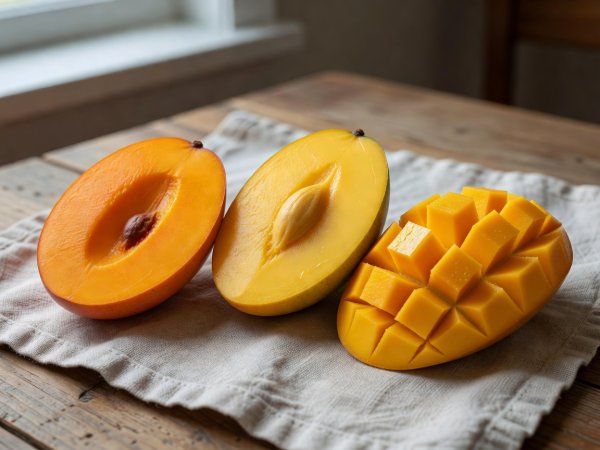
Mangoes belong to the species Mangifera indica, which evolved along two distinct domestication lineages: the Indian monoembryonic group (often intensely aromatic, deeply pigmented, and rich in lactones and furaneol) and the Southeast Asian polyembryonic group (silky, low-fibre, with bright citrus top notes). Use the table below to match your market fruit to the right dessert method.
| Cultivar & Origin | Typical Sweetness (°Brix) | Fibre & Pulp Texture | Acidity Profile | Best Baking Applications |
|---|---|---|---|---|
| Alphonso (Ratnagiri, India) | 18°–22° Brix | Non-fibrous, dense, high carotenoid pigment | Medium-low when fully ripe (pH 4.3–4.6) | Chiffon cakes, baked cheesecakes, kulfi, mousses |
| Ataulfo / Honey (Chiapas, Mexico) | 17°–20° Brix | Buttery, virtually zero stringiness, small flat seed | Balanced, lively tart finish (pH 3.9–4.2) | Mango curds, tart glazes, diplomat creams, sorbets |
| Carabao / Manila (Philippines) | 16°–19° Brix | Extremely tender, delicate pale-gold flesh | Bright, clean malic-citric balance (pH 3.8–4.1) | Mango Royale icebox cakes, fresh tart toppings, puddings |
| Kent & Keitt (Florida / Peru) | 14°–17° Brix | Juicy, firm flesh with minimal fibre near skin | Moderate acidity; Keitt stays tangy even when ripe | Roasted fruit compotes, upside-down cakes, laminated turnovers |
| Tommy Atkins (Americas / Export) | 11°–14° Brix | High cellulose fibres, high free water content | Mild, sometimes muted aromatics | Requires straining and 30% stovetop reduction; best in spiced chutneys or cooked fillings |
The Three-Step Purée Protocol
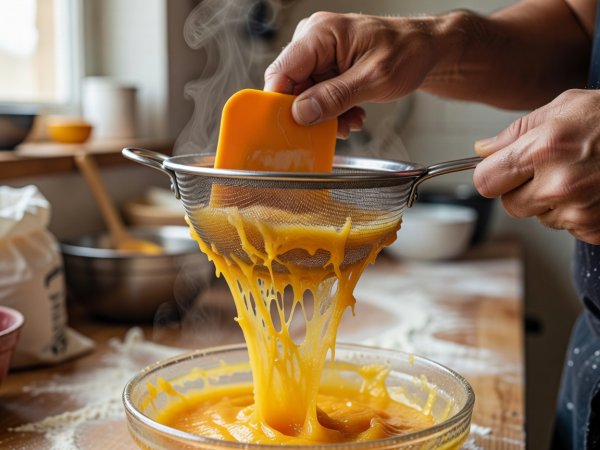
Even a low-fibre mango holds long vascular bundles near the stone. If blended at high speed in a tall countertop blender without straining, two problems occur: first, micro-bubbles of air get trapped in the viscous pulp (causing pinholes in baked cheesecakes and cloudy glazes); second, tiny fibrous threads catch on the wire whip when folding meringue.
Balancing Sweet Terpenes with Acid, Salt, and Fat
Mango aroma is driven by monoterpenes (such as myrcene and ocimene), lactones (which lend coconut-like creaminess), and furaneol. When baked with sugar, eggs, and butter, these warm compounds can easily read as one-dimensional or cloying unless anchored by sharp organic acids and aromatic bitters.
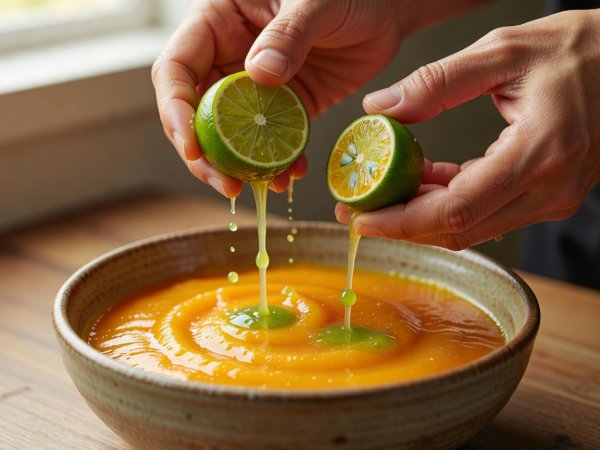
In our test kitchen, every 250 g of ripe mango purée receives both a pinch of flaky sea salt (1.5 g) and between 10 ml and 18 ml of high-acid citrus—most effectively Philippine calamansi, Key lime juice, or strained passionfruit (maracuyá) seed pulp. Where fat is high, as in white chocolate mango ganache or mascarpone cream, freshly crushed green cardamom pods or lime zest oil cuts through the palate coating.