The Gentle Firmness
A memorable mango pudding or cheesecake yields softly to the side of a spoon while holding a clean, luminous edge on the plate. Achieving that quiet poise requires understanding how fruit pulp interacts with dairy proteins (casein and whey), egg custards, and hydrocolloids like leaf gelatin or marine agar-agar.
Too much unreduced mango juice turns a baked cheesecake chalky and split at the edges; too much gelatin turns a Hong Kong dim sum mango pudding bouncy rather than melt-in-the-mouth. Here is how to control both heat and hydration.
Preventing Cracks, Weeping, and Split Dairy
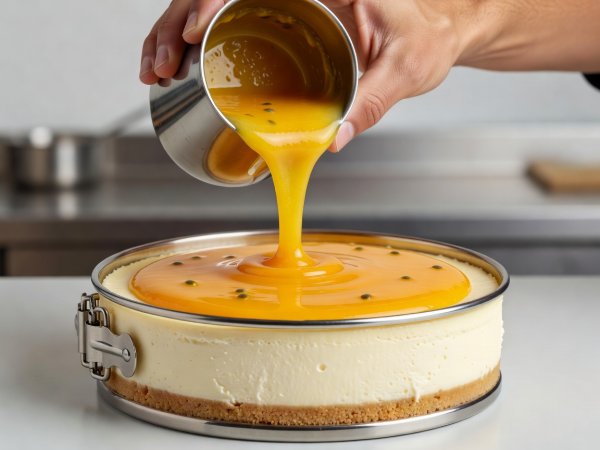
In a baked mango cheesecake, full-fat block cream cheese must sit at 21°C before mixing. If you pour cold or highly acidic mango purée straight into the cream cheese, the casein micelles clump into tiny white flecks that never smooth out. Always whisk your reduced mango purée with the sugar and a touch of cornstarch (15 g per 500 g cream cheese) first, then blend gently on low speed so you do not whip excess air into the batter.
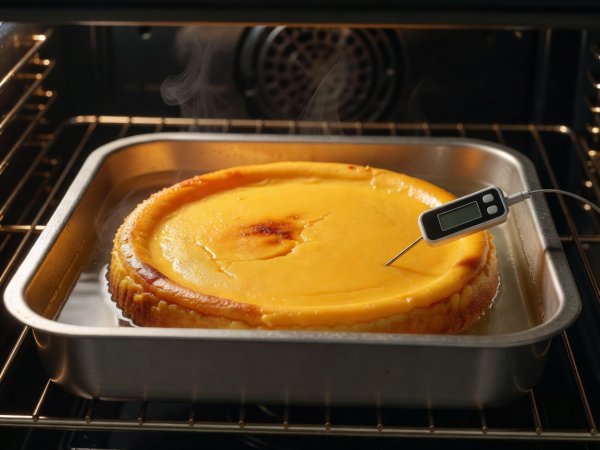
Bake in a water bath (bain-marie) at 160°C until the centre reaches an internal temperature of 65°C–67°C. At this exact point, the egg proteins form a tender three-dimensional mesh without squeezing out moisture.
Gelatin, Agar-Agar, and Pectin Ratios for Mango Desserts
Gelatin melts right around human body temperature (32°C–35°C), giving mousses and classic Hong Kong mango pudding a luxurious creamy release on the tongue. Agar-agar sets firmly at room temperature and requires boiling for 90 seconds to hydrate fully, making it suited to warm buffet tables or plant-based coconut-mango panna cotta.
| Preparation Type | Gelling Agent | Percentage by Total Liquid Weight | Hydration & Thermal Rule | Resulting Texture |
|---|---|---|---|---|
| Hong Kong Mango Pudding | Silver Leaf Gelatin (160 Bloom) or Powder | 1.4% – 1.6% (approx. 8.5 g per 550 g total mix) | Dissolve bloomed gelatin in warm sugar syrup (55°C); never boil with mango pulp | Silky, spoonable quiver that melts immediately on the palate |
| No-Bake Mango Cream Cheese Mousse Cake | Platinum or Gold Leaf Gelatin (200–240 Bloom) | 1.2% – 1.4% of total batter weight | Temper melted gelatin with 3 tbsp warm mango purée before folding into cool cream cheese | Clean knife cuts; light aerated structure with whipped cream |
| Top Mirror Glaze (Miroir Mangue) | Leaf Gelatin + Natural Fruit Pectin | 1.8% gelatin | Pour at 29°C–31°C over a thoroughly chilled cheesecake surface | Translucent, glossy 2 mm top coat that does not slide off |
| Coconut-Mango Layered Agar Jelly | Pure Telephone-Brand or Fine Agar Powder | 0.8% – 0.9% (approx. 4.5 g per 500 ml liquid) | Simmer agar in water/coconut milk at 98°C for 2 minutes; stir in warm mango off the heat | Crisp, clean-breaking bite; stable up to 38°C ambient room warmth |
Anatomy of an Authentic Hong Kong Mango Pudding
Developed in Hong Kong's Cantonese banquet halls and dessert houses (tong sui铺), great mango pudding relies on a three-temperature technique. First, only 30% of the liquid (water, sugar, and a pinch of salt) is warmed to 60°C to dissolve the bloomed gelatin. Second, 400 g of raw, cold Carabao or Alphonso mango purée is whisked in immediately so the fruit never tastes cooked.
Third, cold evaporated milk (or light whipping cream) and 1 cm cubes of fresh mango are folded in just as the mixture cools to 22°C—slightly viscous so the diced fruit stays suspended evenly from top to bottom rather than sinking to the base of the mould.